Wednesday, January 17, 2024

Hopewell in Illinois

If you're not following Greg Little on Twitter (X), you're missing lots of interesting posts. Here's another one:


The Gramercy Park Mounds in East Dubuque, IL, AKA "Dunleith Mounds." There were 26 Hopewell Culture mounds in this 3-acre park. The 5th Annual Report of the Bureau of Ethnology (1887) devoted several pages to their excavation. A skeleton over 7' in height was found along with other oddities.


Tuesday, January 16, 2024

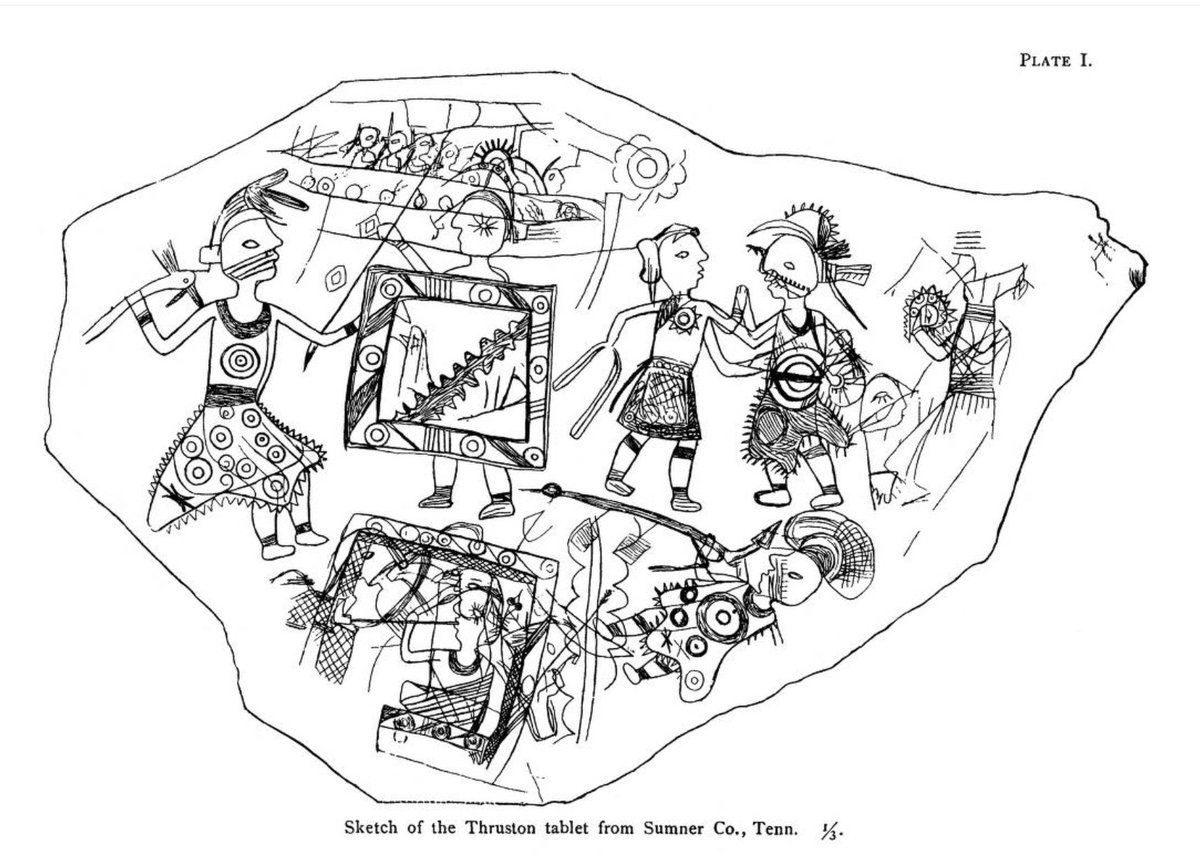
Thruston tablet

The Thruston Tablet, found in Tennessee, is subject to a variety of interpretations.

Illustration of the Thruston Tablet. It is a (paraphrasing) "19 inch long, 15 inch wide, 1 inch thick slab of stone" found at Rocky Creek in Sumner County, Tennessee around 1878. From: Holmes 1891.

(click to enlarge)


Little is known about the dating of this piece, but here is one discussion of the various issues.

https://dnaconsultants.com/the-invention-of-the-cherokee-people/

Tuesday, January 9, 2024

Daniel H. Ludlow and the 2 sets of plates

An article by Daniel H. Ludlow reminded me of another evidence that Joseph translated two separate sets of plates.

https://archive.bookofmormoncentral.org/sites/default/files/archive-files/pdf/ludlow/2016-02-09/07_daniel_h._ludlow_the_title_page_2001.pdf

To summarize:

1. The abridged plates which Joseph took from Moroni's stone box and translated in Harmony. Before leaving Harmony, Joseph gave the abridged plates to the divine messenger who took those plates back to the Hill Cumorah. Joseph identified the messenger as one of the Three Nephites.

2. The small plates of Nephi which Joseph translated in Fayette after the messenger brought those plates from the repository in Cumorah. This messenger also showed those plates to Mary Whitmer, introducing himself as "Brother Nephi." 

[Unfortunately, Andrew Jensen, who compiled early Church history, assumed Mary was wrong and changed the narrative to read that it was Moroni who showed Mary the plates. Apparently Jensen didn't know that Joseph had identified the individual as one of the Three Nephites, or that David Whitmer had a conversation with both the messenger and with the actual Moroni and knew they were separate individuals. Nevertheless, to accommodate M2C which claims Cumorah is in southern Mexico, LDS scholars prefer the Jensen narrative, which is not only contrary to the historical records but also highly problematic from a doctrinal standpoint as it promotes the idea that resurrected beings (such as Moroni) can change their shape, age, and overall appearance to mislead mortals (such as by appearing as an old, short, overweight man).]

_____

Back to Ludlow.

In his article, Ludlow reminds us that Joseph Smith explained that "the title-page of the Book of Mormon is a literal translation, taken from the very last leaf... and that said title page is not by any means a modern composition."

Far from being words that appeared on a stone in the hat (SITH), the title page is "a literal translation" taken from a specific leaf of the plates.

Years ago at BYU Education Week, I head one of the educators discuss Church history and actually say, "We don't know how Joseph knew the Title Page was on the last leaf because he didn't even use the plates. They were covered by a cloth when he read the words off the stone in the hat."

That's how absurd the SITH narrative has become.

Ludlow also reminds us that the copyright application of 11 June 1829, and the setting of the type for the title page in "the forepart of June 1829" by Gilbert, both occurred while Joseph was still translating the plates of Nephi in Fayette. Because the Title Page was the last leaf of the plates Joseph had in Harmony, the plates he was translating in Fayette had to be a different set of plates; i.e., the small plates of Nephi that he did not have in Harmony.

The alternative view--that Joseph had the plates of Nephi all along--would require that Joseph did not translate the plates in sequence, that the directions in D&C 10 to translate the "plates of Nephi" were superfluous because he already had the plates, and that the discrepancies in the descriptions of the plates and the different accounts of how Joseph returned them will forever remain a mystery.

But people can believe whatever they want to believe.

_____

See the diagram of the two sets of plates here:

http://www.lettervii.com/p/the-two-sets-of-plates-schematic.html


Monday, January 8, 2024

Lehi's route

Readers of the Book of Mormon want to know how Lehi came to America. This little animation shows the most plausible route, which happens to also be the only one validated by an actual crossing using technology from 600 BC.


The Book of Mormon is a simple, direct narrative that is easy to understand when we heed the text, the teachings of the prophets, and the extrinsic evidence.

Monday, January 1, 2024

The coming forth of the Book of Mormon

The title of this blog, Letter VII, refers to the seventh of eight essays about Church history written by Oliver Cowdery in 1835 when he was the Assistant President of the Church (an office that ranked higher than the counselors in the First Presidency).

In Joseph Smith's day, these 8 essays were the best-known history of the Church. Oliver wrote from personal knowledge, with the assistance of Joseph Smith. He published them over several months as letters in the Messenger and Advocate in Kirtland in 1834-5. Joseph had his scribes copy the essays into his own journal as part of his life story. (See link below.)

Oliver wrote the essays with the express assistance of Joseph Smith. For example, Oliver mentioned that Joseph couldn't tell him exactly what time it was when Moroni first visited, but it was after everyone had gone to bed. Oliver described Moroni's appearance, Joseph's frame of mind when he first went to the Hill Cumorah, how the stone box was constructed, and many more important details.

In 1840, Joseph asked his brother Don Carlos to re-publish the essays in the Times and Seasons in Nauvoo. He gave Benjamin Winchester permission to re-publish them in the Gospel Reflector, which was Winchester's newspaper in Philadelphia. Parley P. Pratt also re-published them in the Millennial Star in England. Also in England, the essays were published as a separate pamphlet that sold thousands of copies.

An excerpt from Letter I was canonized as the note to JS-History in the Pearl of Great Price.

In Utah, Joseph F. Smith republished the essays in the Improvement Era.

However, most modern Latter-day Saints have never even heard of these important essays. Few have read them. 

_____

Latter-day Saints frequently ask why they haven't heard of these essays before. It is easy to understand why certain prominent LDS scholars downplay these essays. Oliver Cowdery explicitly reaffirmed the dual facts that (i) Joseph Smith translated the record with the Urim and Thummim and (ii) the Hill Cumorah of Mormon 6:6 is the same hill where Joseph found the plates. 

Readers of this blog recognize the implications. In these essays, Joseph and Oliver explicitly repudiated both SITH (the stone-in-the-hat theory of translation) and M2C (the Mesoamerican/two-Cumorahs theory of geography).

Consequently, those who promote SITH and M2C prefer that Latter-day Saints don't even know about these essays, let alone read them.

I find it ridiculous and counterproductive to suppress authentic, accurate Church historical documents, especially documents written by Joseph and Oliver that were so widely published at Joseph's direction. But modern LDS scholars have somehow rationalized their censorship.

Fortunately, the Joseph Smith Papers have preserved Joseph's journals so we can all read them there. 

_____

Letter IV relates the visit of Moroni. It's well worth reading in full, but here's an excerpt from this link:

https://www.josephsmithpapers.org/paper-summary/history-1834-1836/68

Notice that Moroni told Joseph from the outset that the record was "written and deposited" not far from Joseph's home in Palmyra. IOW, we've known all along that it was not written in Mesoamerica and transported thousands of miles to western New York.

"written and deposited not far from that place"
(click to enlarge)

This should be a given, but our M2C scholars have managed to obfuscate and confuse people by suppressing this account of what Moroni said.

Therefore, marvle not if your name is made a derission, and had as a by-word among such, if you are the instrument in bringing it, by the gift of God, to the knowledge of the people.”

He then proceeded and gave a general account of the promises made to the fathers, and also gave a history of the aborigenes of this country, and said they were literal descendants of Abraham. He represented them as once being an enlightned and intelligent people, possessing a correct knowledge of the gospel, and the plan of restoration and redemption. He said this history was written and deposited not far from that place, and that it was our brother’s privilege, if obedient to the commandments of the Lord, to obtain and translate the same by the means of the Urim and Thummim, which were deposited for that purpose with the record.

Because this fits so well with the first week of Come Follow Me, be sure to share it with everyone you know.




Friday, December 15, 2023

Pre-Christmas Kindle sale - The Rational Restoration


When the first Kindle was released in 2007, I bought one right away. It was a little clunky, but it was better than other e-readers at the time.

I showed mine to some well-known authors who had yet to see one back then, including R.L. Stine, Lee Child, and several others, many of whom signed the back of my Kindle just for fun. 

Back then, the ability of the Kindle to download books over the Internet seemed amazing. We could use it for email as well. (One of our kids sent us email from North Korea on a Kindle, which the authorities had let him keep during a tour there because he said it was a translator, not a phone.)

Since then we've owned several Kindle devices, but now I hardly ever use them because the Kindle apps on our phones, tablets, and laptops are so much easier to use.

Which leads me to the Pre-Christmas Kindle sale.
_____

We decided to put the Kindle version of The Rational Restoration on sale for the next 10 days for only $4.99. 

https://www.amazon.com/Rational-Restoration-Reframes-pursuit-understanding-ebook/dp/B0CHXRY2ZJ

[Note: anyone who bought a Kindle version in the last 30 days at the regular price can email me at lostzarahemla@gmail.com for a free special .pdf]
_____

You can see the Table of Contents here:


You can also download a sample of the book on Kindle, which includes the Table of Contents.
_____

You don't need a Kindle device to read Kindle books. You can easily download the Kindle app on your PC, laptop, phone, or tablet. Then you can read your Kindle books anywhere. You can sync your devices so they keep you on the latest page you've been reading.
_____

You can give Kindle copies as gifts. It's easy. Here are the instructions from the Amazon website:

Buy Kindle Books for Others

You can use your Amazon account to purchase Kindle books in bulk and distribute them to others.

Note: Kindle eBooks can only be redeemed by recipients in your same country. Recipients outside your country cannot redeem any Kindle eBooks sent to them. You can distribute any unredeemed copies to other recipients or request a refund.

To buy Kindle books for others:

  1. Go to the Kindle eBook's product detail page on Amazon.
  2. In the Buy for others box select the quantity you want to purchase.
  3. Select the Buy for others button and then enter the details for your gift recipients.

    You can specify recipient email addresses on the checkout page to send each recipient an email with the link to redeem the eBook. Any eBooks not sent are available, after completing your purchase, to be sent when you choose.

    If you didn't provide a recipient email address, instructions on how to manage your books are emailed to you after the order is complete. Go to Send Kindle Books to Individual Recipients for more information.

Wednesday, December 13, 2023

Ephesus, before and after excavation


2,300-year-old Grand Theatre of Ephesus, in Turkey, before and after excavation.